Call for Papers : Africa Journal of Leadership and Governance (AJOLG)
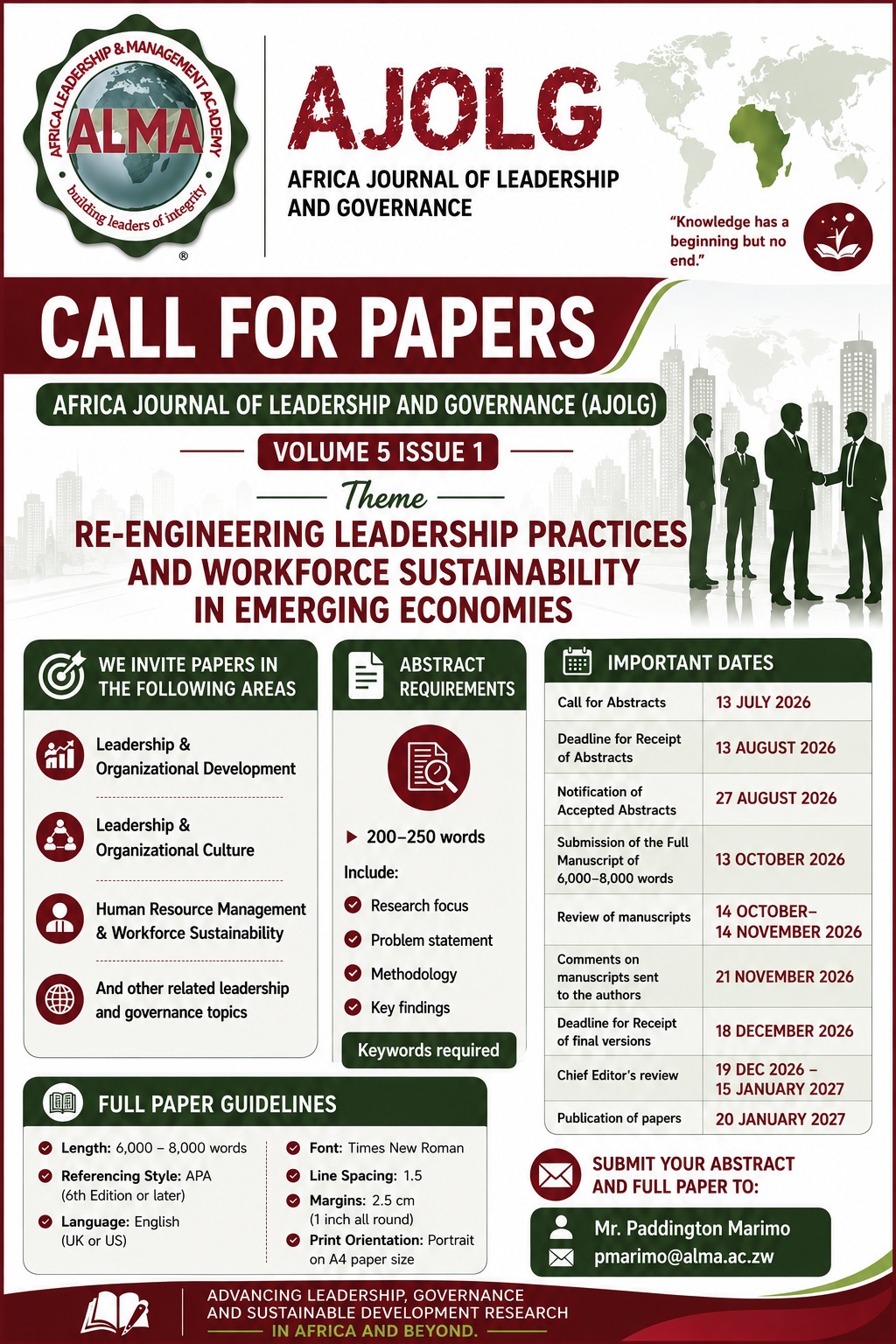
Call for Papers:Africa Journal of Leadership and Governance (AJOLG) 13 July 2026
Re-Engineering Leadership Practices and Workforce Sustainability in Emerging Economies
1 Brief description of the journal
The Africa Journal on Leadership and Governance (AJOLG) is a publication that seeks to bring together scholars from around the globe to share insights, theories, and practices on leadership and governance, with a special focus on the African continent. The publication is biannual, and all published journal articles undergo a rigorous, double-blind peer review by experts in leadership and governance. The journal provides a space for sharing and debating social, political, and economic issues within leadership and management. The publication outputs are not only for academic consumption but also for policy considerations by organizations and local and central governments in Africa and around the globe. The journal provides an open-source platform to promote transformative learning in good and sustainable leadership and governance practices. In addition, AJOLG is a scholarship platform that challenges scholars to advance epistemic democracy and justice in the production and use of knowledge systems in Africa.
The publication is co-managed and co-published by institutions in the International Leadership Consortium (ILC) of International Leadership Universities under the Campus Crusade for Christ. The journal's administrative arrangement attests to its diversity in terms of academic views, fields of specialization in leadership and governance, and the dynamics of socio-cultural, religious, and political factors, as well as its geographical spread.
2 Brief description of the Call for Papers
It is expected that the authors of the papers will highlight the vital role of leadership and strategic thinking in organizational effectiveness and sustainable development. In addition, the authors should provide empirical evidence for the theory and policy contribution to academia and organizational development. Therefore, the call for papers is sought in the following thematic areas, but one can explore other relevant issues beyond this list.
2.1 Leadership and Organizational Development
2.2 Leadership and Organizational Culture
2.3 Human Resource Management and Workforce Sustainability
3 Length and content of the abstract
Each abstract must be between 200 and 250 words. A one-paragraph abstract is required that highlights the following: the paper's focus, the problematization of the subject matter, the methodology, and a summary of the major findings and conclusions. When you submit your abstract, use the following template and ensure to list keywords at the end of the abstract.
4 Format of the full paper
4.1 Referencing style: American Psychological Association (APA), 6th or later edition
4.2 Language preference: English UK or USA. Whichever type of English you prefer; you must consistently use it throughout the abstract and the full paper.
4.3 Font style and line spacing: Times New Roman; 1.5 Line Spacing
4.4 Margins: Maintain the standard margins of 2.5cm (1 inch all round)
4.5 Print orientation: Portrait on A4 paper size
4.6 Notes to text: If you must, please use footnotes but not endnotes.
5 Length of the full paper The paper should be between 6,000 and 8,000 words.
6 Structure of the full paper The following is the structure guideline for the full papers:
6.1 Abstract
• The abstract should cover the paper's focus, objectives, key findings, key conclusions, and key recommendations or suggestions for future research.
6.2 Introduction
• This should include a clear problematization of the issue under focus and a concise statement of the problem and objectives.
6.3 Literature review
• To include a theoretical or conceptual framework underpinning the paper's focus, as well as a brief empirical literature review.
6.4 Methodology
• Clearly articulate and justify the methodology applied in the development of the paper.
6.5 Presentation and Discussion of Results
• Clearly present the results and ensure that the discussion of the results adequately interfaces with the existing literature on the subject matter.
6.6 Conclusions and Recommendations
• This requires you to include conclusions, recommendations, or suggestions for future research on the policy level in line with the subject matter.
7 Timelines
Call for Abstracts 13 July 2026
Deadline for Receipt of Abstracts 13 August 2026
Notification of Accepted Abstracts 27 August 2026
Submission of the Full Manuscript of 6,000-8,000 words 13 October 2026
Review of manuscripts 14 October -14 November 2026
Comments on manuscripts sent to the authors 21 November 2026
Deadline for Receipt of final versions 18 December 2026
Chief Editor’s review 19 Dec-15 January 2027
Publication of papers 20 January 2027
8 Submission May you please email your abstract and full paper to: Mr. Paddington Marimo (pmarimo@alma.ac.zw )
Gallery
- Author ADMIN
- Published Jul 13, 2026